SentinelOS Policy
Policy signals. Regional data. Real pathways.
Issue #1 — Q3 2026
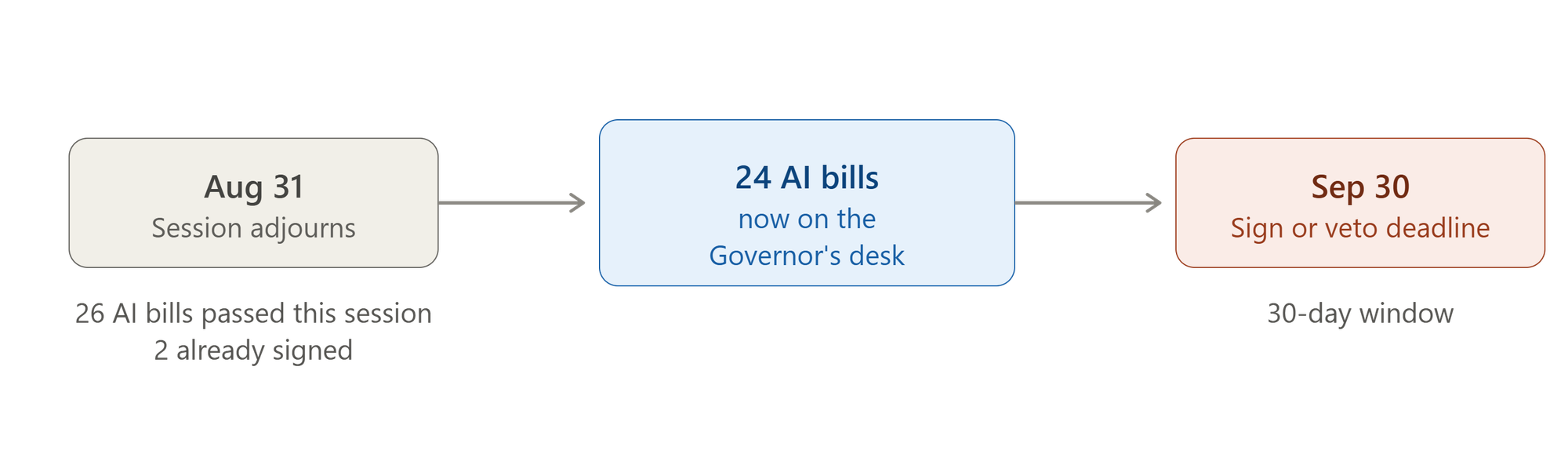
Publisher's note on timing: This issue publishes the final day the California Legislature's Session, which will adjourn sine die this year. Lawmakers worked past midnight yesterday to close out most of the 2026 session, ultimately passing 26 AI-related bills this year. Two are already signed into law; the remaining 24 now sit on Governor Newsom's desk, and he has until September 30, 2026 to sign or veto each one. That 30-day window is this quarter's most concrete "exposure-to-action" clock: every organization named in Sections 4 and 5 has a defined, dated reason to act before it closes, not after.
Executive Summary
California just closed the most active AI-workforce legislative session in its history. In the past 90 days: a governor's executive order directing five state agencies to recommend new worker protections, a wave of AI-employment bills that survived the Legislature's suspense-file gauntlet and final floor votes to reach the Governor's desk, a new state dashboard tracking AI's employment impact using real unemployment data, and, the standout finding this issue, the first state framework anywhere in the country for who is legally authorized to audit an AI system.
Most organizations tracking this are getting one of two things: a legal compliance memo with no labor-market data behind it, or a labor-market report with no connection to what's actually pending in Sacramento. SentinelOS Policy exists to close that gap. For every policy item we track, we answer three questions: who is exposed, how much, and what funding or pathway exists to respond.
This issue covers:
Two workforce-displacement bills now on the Governor's desk (SB 951, SB 947) and what they mean by region and industry. A first-in-the-nation AI auditor framework (AB 1405, SB 813) that creates a new compliance occupation before any labor-market data exists to track it. A first look at our AI-exposure spine metric, piloted on nursing and software development occupations, now anchored with real statewide occupation counts. A regional snapshot comparing exposure and adoption across two California regions, including fresh Sacramento MSA employment data pulled this issue Emerging grant and technical-assistance pathways tied directly to this quarter's policy activity
Section 1: Legislative & Regulatory Watch
Every bill status below reflects the Legislature's final actions through its August 31 adjournment. All are now with the Governor, who has until September 30 to act.
SB 951 — "Worker Displacement Notice" (Sen. Eloise Reyes)
Status: Final. Passed the full Senate 28–9 on May 20; survived the August 13 Assembly Appropriations suspense hearing (approved 10–3); amended and ordered to third reading August 24; the Senate approved the Assembly's amendments (concurrence) on August 31, sending the bill to Governor Newsom's desk.
What it does: Requires 90 days' advance written notice from covered employers before a technological displacement affecting 25% or more of the workforce.
Exposure-to-Action:
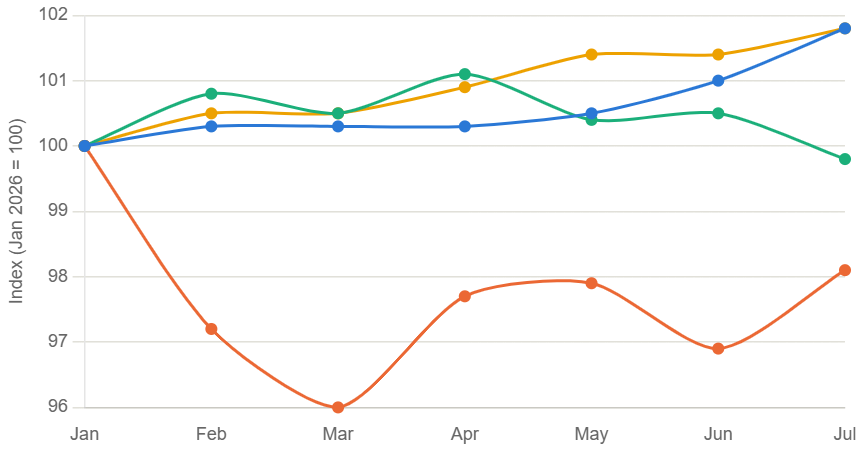
Map: This bill's trigger conditions apply broadest to industries with concentrated mid-size employers (logistics, manufacturing, back-office/administrative services, and customer service functions) rather than to professional services with more distributed headcount. Quantify: Sacramento-Roseville-Folsom MSA employment in the supersectors closest to SB 951's exposure profile, as of July 2026 (EDD, not seasonally adjusted):
Manufacturing, 39,400 — up from 38,700 in January, +1.8% year-to-date.
Transportation, Warehousing, and Utilities, 41,800 — down from 42,600 in January, -1.9% year-to-date.
Professional and Business Services — the closest available proxy for back-office/administrative functions, though a broader category that also includes legal, accounting, and consulting — 133,100, essentially flat at -0.2% year-to-date.
For scale: statewide, California businesses with 20 or more employees make up only about 8% of all establishments but account for roughly 74% of total employment (EDD Size of Business report, Q4 2025): meaning a 25%-of-workforce trigger, in practice, concentrates SB 951's compliance burden on a relatively small share of employers who nonetheless employ most of the state's workforce.
A Sacramento-specific employer count by these NAICS codes, and the AEI task-exposure overlay for this trend line, are the priority data pulls for Issue #2. Match to funding: The bill's companion executive order (N-6-26) directs the LWDA to review and recommend WARN Act revisions by November 17, 2026 - a separate, administrative track running alongside whatever SB 951 itself requires once signed. Client angle: Employers in exposed sectors now have a defined 30-day window, through September 30, to address the Governor or start to plan for SB 951 taking effect in January 2027, rather than an open-ended "if passed" scenario. Workforce boards need to understand which local employers are likely to trigger notice requirements, to plan Rapid Response capacity.
SB 947 — "No Robo Bosses Act" (Sen. Jerry McNerney, Sen. Eloise Reyes)
Status: Final. Passed the full Senate 29–9 on May 19; survived the August 13 Assembly Appropriations suspense hearing; received final approval August 31 and was sent to Governor Newsom's desk.
What it does: Establishes worker protections regarding employer use of automated decision systems (ADS), including limits on ADS use in certain workplace management and disciplinary functions without human review, and a worker right to request the data an ADS used to make decisions about them.
A related bill passed alongside it, AB 1883 (Asm. Bryan), sent to the Governor August 28. It's narrower and, as far as we've found, unprecedented in scope: it would bar employers from using AI-based workplace surveillance tools to collect a worker's "neural data" or identify their emotional state. That's a genuinely new category of workplace-tech regulation — biometric/neural surveillance, distinct from SB 947's broader scheduling-and-discipline ADS focus — worth tracking as its own compliance item.
Exposure-to-Action:
Applies broadly to any employer using algorithmic scheduling, performance monitoring, or disciplinary tools, a wider net than SB 951, cutting across retail, warehousing, gig-adjacent industries, and large-scale service employers. AB 1883 applies more narrowly, to employers using biometric, wellness-tracking, or emotion-detection workplace tools specifically. Any California employer using scheduling software, productivity monitoring, or biometric/wellness-tracking tools should inventory those tools now against both bills' definitions.
SB 947 is this session's second attempt at the same core idea. Gov. Newsom vetoed its 2025 predecessor, SB 7, as overbroad, pointing to existing CPPA automated-decision-making rules as already covering the concern. A broader companion effort this session, AB 1018 (Bauer-Kahan), which would have required disclosure whenever an ADS played a role in employment, housing, or healthcare decisions, did not pass before adjournment.
Read together: the Legislature converged on the narrower SB 947/AB 1883 approach over broader disclosure mandates, consistent with last year's veto message, and a reasonable signal for how Newsom may lean this time.
Client angle: This is a compliance-readiness conversation for HR and operations leadership at mid-to-large employers, and a policy-education conversation for chambers and industry associations whose members will ask "does this apply to us?" - with a hard deadline now attached: September 30 or Governor action and an effective date of January 2027.
AB 1405 (Asm. Bauer-Kahan, Sen. McNerney) and SB 813 (Sen. McNerney): California's First AI Auditor Framework
Status: Final. Both passed and were sent to Governor Newsom's desk (SB 813 on August 30). Both are backed by Anthropic, which publicly commended the bills' authors "for their leadership on these important issues", consistent with the company's support for last year's SB 53 frontier-AI transparency law. Newsom has not signaled a position on either.
What they do, together: AB 1405 creates a state registry and ethical-practice rules for independent auditors who assess AI systems, including independence-from-the-audited-company requirements. SB 813 creates a state commission that recognizes private organizations developing voluntary AI safety standards and certifies developers who meet them. The two function as one framework: the commission sets recognized standards; the registry supplies the auditors qualified to verify compliance against them.
Why this is the strongest finding this quarter: this is regulatory infrastructure arriving before the labor-market data that would normally signal it. No postings data exists yet for "AI compliance auditor" or "Independent Verification Organization specialist," because the credential that would create the occupation doesn't exist yet. A publication working from postings data alone won't see this coming.
Exposure-to-Action:
Two audiences carry exposure here. First, every organization already facing AI-audit obligations under California law (health plans and insurers under SB 1120's physician-override audit mandate, health systems and vendors under AB 1979's clinical-documentation requirements, employers under SB 947/AB 1883's ADS compliance regime) now has a first look at what a state-recognized verification channel could look like.
Second, GR firms, compliance consultancies, and technical-assurance vendors considering entering the AI-audit market itself need to track registry eligibility and independence rules before they stand up.
Match to funding: None directly yet, but this is the connective tissue between every other audit/compliance obligation already tracked in this issue — a client managing compliance under SB 1120, AB 1979, or SB 947/AB 1883 doesn't yet know who they'll eventually be allowed to hire (or report to in the government) to verify it.
Client angle: For regulated entities: map which of your compliance obligations will eventually require third-party verification, ahead of the registry opening. For prospective auditors and compliance vendors: AB 1405's independence and ethics rules will determine who's eligible to enter this market at all.
AI in Clinical & Behavioral Health Decision-Making — AB 2575, AB 1979, SB 503, SB 903
Status: All final, all with the Governor. AB 2575 (Asm. Ortega) passed the Assembly May 27 and the full Senate August 31. AB 1979 (Asm. Bonta) was sent to the Governor August 28. SB 503 (Sen. Weber Pierson) was sent August 30. SB 903 (Sen. Padilla, Sen. Rubio) was sent August 31.
AB 2575 — the most contentious of the four. Backed by the California Nurses Association and labor, it would protect health workers from retaliation or discipline for exercising independent clinical judgment, including overriding an AI-powered clinical decision support system. Opposed by the California Medical Association, California Hospital Association, and California Chamber of Commerce, who argue the requirements amount to a de facto ban on clinical AI tools. AB 1979 — as passed, its central mechanism extends the Confidentiality of Medical Information Act (CMIA) to health care chatbots, treating a business offering one as a "provider of health care" subject to CMIA's privacy obligations. Earlier committee language in the bill also preserves clinicians' authority to override AI-generated recommendations and bars AI from directing unlicensed staff to perform tasks that require a professional license. SB 503 — requires developers and deployers of AI systems used in clinical decision-making to identify, monitor, and mitigate biased outcomes, with a standardized testing and disclosure framework. SB 903 — concerns AI's role in transcribing patient information during professional mental health therapy sessions, and restricts AI tools from representing themselves as licensed therapy providers. Worth tracking alongside AB 1979 as a second, behavioral-health-specific thread distinct from the physical-clinical-decision fight above.
Also sent to the Governor this week, adjacent to but not part of this AI cluster: AB 1331 (Asm. Elhawary), which bars employers from using surveillance, including in restrooms, against workers. Not AI-specific, but part of the same broader workplace-surveillance regulatory wave as SB 947/AB 1883 above, and worth a single line for readers tracking that trend.
Exposure-to-Action:
Directly relevant to every hospital, health system, clinical AI vendor, and behavioral-health platform operating in California, and directly relevant to the nursing pilot occupation in Section 2, since this is the live legislative outcome on how much clinical authority nurses retain relative to AI systems.
Read on likely outcome: the dynamic here mirrors the SB 947/SB 7 pattern above and last year's chatbot safety fight, where the industry dropped opposition to workable bills while mobilizing against a stricter one. Watch for a similar split among these four: SB 503, AB 1979, and SB 903 signed with AB 2575 held or vetoed would be consistent with that pattern, with AB 2575's fate a bellwether for whether broader clinical job-protection language gains traction in a future session even if it fails this year.
Client angle: health systems, clinical AI vendors, and behavioral-health platforms should prepare for bias-testing, chatbot-privacy, and disclosure obligations regardless of which combination is ultimately signed - SB 503, AB 1979, and SB 903 all carry a plausible path to enactment.
Executive Order N-6-26 (signed May 21, 2026): directs LWDA, EDD, GO-Biz, and the Civil Rights Council to deliver coordinated AI workforce policy recommendations, most due by November 17, 2026, the umbrella under which SB 951 and related WARN Act questions will likely be further resolved administratively. SB 1119, "Adam's Law" (Sen. Padilla, Asm. Wicks, Asm. Bauer-Kahan): Final. Passed the full Senate 39-0 on May 19 and the full Assembly on August 31, folding in a related bill (AB 2023) along the way. Updates California's existing companion-chatbot safety law (SB 243, enacted last year) with additional child-safety components. The bill is named for a California teen whose 2025 death was linked to an AI chatbot interaction. Sent to the Governor's desk. AB 2504 and AB 2545 (community college AI-reskilling pilot and DIR labor-impact reporting, respectively): no update to report this issue (status unchanged from our last check. EDD's UI-data-based AI employment dashboard remains live) a free complement to our CAIT-based spine metric, worth cross-referencing each quarter. Outside this issue's workforce scope, but part of the same final-night wave: bills addressing teen social-media design limits (AB 1709) and autonomous-vehicle incident response. Noted here for completeness; not covered further, consistent with this publication's regional/workforce focus.
Section 2: Pilot Occupation Spotlight — Nursing & Software Developers
Methodology note: figures below combine California-filtered AI-skill demand data (job postings, sourced via the Bipartisan Policy Center's public AI Skills Dashboard, powered by Lightcast) with our exposure-to-outcome spine metric, the Anthropic Economic Index's task-level AI exposure scoring paired with the California Policy Lab/EDD's CAIT unemployment-outcomes data, to distinguish theoretical exposure from what's actually happening to real workers and real employer demand.
Statewide AI-skill demand (California, trailing 365 days):
| Skill | Postings | YoY Growth | Median Advertised Salary |
|---|---|---|---|
| Artificial Intelligence (general) | 214,169 | +146.5% | $171,776 |
| Machine Learning | 88,234 | +30.4% | $198,400 |
| Generative AI | 32,787 | +70.8% | $191,232 |
| PyTorch | 16,316 | +19.3% | $206,592 |
| Large Language Modeling | 11,526 | +54.7% | $199,424 |
| ChatGPT | 9,045 | +322.9% | $104,192 |
| Prompt Engineering | 8,293 | +208.4% | $182,016 |
Software Developers: California employed 284,390 Software Developers statewide as of Q1 2026 (EDD Occupational Employment Statistics), a solid anchor figure alongside the skills-demand table above, which shows sustained double- and triple-digit growth in AI/ML-specific postings layered on top of that occupational base.
Registered Nurses: California employed 338,940 Registered Nurses statewide as of Q1 2026 (EDD OES). At the regional level, the Sacramento-Roseville-Folsom MSA's Nursing and Residential Care Facilities industry (a broader NAICS category covering all staff at nursing homes and residential care facilities, not RNs specifically) employed 22,500 as of July 2026, up from 22,100 in January (+1.8% year-to-date). What we can say now: statewide RN employment is holding steady and the regional nursing/residential-care industry is growing modestly, even as the legislative fight over clinical AI authority (Section 1) plays out in real time. A reminder that for this occupation, AI exposure currently reads as a policy and standards question first, and a headcount question second.
Why this pairing matters: these two occupations carry opposite public narratives. Nursing is often framed as "AI-resistant," software development as "AI-exposed." Pairing employer demand data with task-level exposure and outcomes lets us test both claims against reality rather than assumption. This is the core differentiator of SentinelOS Policy relative to postings-based exposure tools alone: we tell you what's happening, not just what's plausible.
Section 3: Regional Snapshot — Sacramento-Roseville-Folsom
Fastest-growing industries by AI-skill job postings, past 12 months:
| Industry Sector | Postings | YoY Growth | Median Advertised Salary |
|---|---|---|---|
| Employment Placement Agencies | 746 | +253.6% | $87,808 |
| Direct Health and Medical Insurance Carriers | 302 | +172.1% | $123,648 |
| Engineering Services | 249 | +141.7% | $122,624 |
| Administrative Management & General Mgmt Consulting | 256 | +118.8% | $134,912 |
| All Other Telecommunications | 251 | +107.4% | $151,296 |
| Computer Systems Design Services | 742 | +86.9% | $188,160 |
| Offices of Certified Public Accountants | 259 | +67.1% | $161,536 |
| Software Publishers | 408 | +42.2% | $166,656 |
The finding worth leading with: the second-fastest-growing sector for AI-skill demand in the Sacramento region is health and medical insurance carriers, and this growth is happening directly on top of a new regulatory constraint. Under SB 1120 ("The Physicians Make Decisions Act"), effective January 1, 2025, California health plans and disability insurers are prohibited from denying, delaying, or modifying care based on medical necessity using AI alone; a licensed physician must make the final call, and insurers' AI systems are now subject to state audit and compliance review. The sector adopting AI fastest in this region is also the one operating under the state's newest, most specific human-oversight mandate. That's a live compliance conversation for every health plan and insurer hiring against this trend line right now — not a future one.
Note: this is payer/insurance-side healthcare data, not direct patient care (hospitals, clinics, nursing), a useful complement to the nursing pilot spotlight above. See Section 1 for this issue's fresh Sacramento MSA employment pulls in Manufacturing and Transportation/Warehousing/Utilities, the two supersectors most directly exposed to SB 951's notice requirements.
Regional infrastructure watch: data center electricity rules. Two competing bills, SB 886 (Padilla) and AB 2383 (Zbur), would establish California's first major laws regulating how data centers' electricity use is billed and sourced, directly relevant to a region already showing double- and triple-digit AI-skill demand growth in Computer Systems Design and Software Publishing, sectors tied to the physical data center buildout that supports them. As of late August, the CPUC had proposed amendments to SB 886 that would strip a requirement for data centers to secure their own long-term power contracts or dedicated zero-emission generation, and would expand the bill's reach to municipal utilities, changes industry-friendly negotiators and ratepayer advocates read very differently. Because the two bills can't both become law as written without creating conflicting statutes, this has been flagged as a priority watch item for Issue #2.
Section 4: Emerging Pathways & Grants
SB 1120 compliance readiness: health plans and insurers in the Sacramento region hiring against the AI-adoption growth above should assess utilization review workflows now against SB 1120's physician-review and audit requirements — this is enacted, current law, not a future risk. AB 2575 / AB 1979 / SB 503 / SB 903 monitoring: health systems, clinical AI vendors, and behavioral-health platforms should prepare for bias-testing, chatbot-privacy, and disclosure obligations now, ahead of the Governor's September 30 deadline — waiting for final signature decisions leaves no runway to adjust workflows before effective dates. AB 1405 / SB 813 registry watch: no funding or compliance pathway exists yet, but any organization with existing AI-audit obligations (SB 1120, AB 1979, SB 947/AB 1883) should track the registry's launch timeline once the Governor acts, since it will define who they're eventually permitted to hire for third-party verification. WIOA technical assistance for AI literacy programs: EDD is directed to develop an AI playbook and provide local workforce boards technical assistance on using existing WIOA resources for AI-literacy training, available now, ahead of any new appropriation. AB 2504 community college pilot funding: status unchanged this issue, worth continued tracking for community college clients as an appropriations target. LWDA WARN Act review (due November 17, 2026): not a grant, but a comment/input window, associations and employers with a stake in the outcome should plan engagement before recommendations are finalized. Data center electricity rulemaking (SB 886/AB 2383): not a funding pathway, but a siting-and-cost variable that will affect any regional economic-development pitch built around data center jobs growth, worth monitoring alongside the CPUC's proceeding.
Section 5: What This Means For You
Sacramento-Roseville-Folsom Region Workforce Development Boards: Rapid Response capacity planning against SB 951's notice thresholds, with particular attention to Computer Systems Design and Software Publishing employers given their concentration in this region; early positioning for WIOA AI-literacy technical assistance.
Worth noting: national polling (ITIF, Aug. 2026) finds Americans oppose new data centers built specifically to train AI models at meaningfully higher rates (33%) than data centers built for other uses like banking or streaming (24–26%), a useful caution for any regional messaging that leans on AI-training data center buildout as a straightforward jobs win with local constituents.
Community Colleges: Track AB 2504 for reskilling pilot funding; benchmark current nursing and health-sciences program content against the AB 2575/AB 1979/SB 503/SB 903 clinical and behavioral-health AI fight, and IT/software program content against the statewide AI-skill demand data above.
Cities & Counties: Understand local employer concentration in SB 951/SB 947-exposed industries (Sacramento's insurance-carrier and consulting-services growth in particular) to anticipate Rapid Response and constituent impact. Also watch the SB 886/AB 2383 data center electricity fight directly, since its outcome affects local siting and ratepayer politics.
Chambers & Industry Associations: Member education on SB 947/AB 1883 compliance, including AB 1883's new biometric/neural-data surveillance restrictions; aggregate member input ahead of the LWDA's November review window.
Health Plans, Insurers & Health Systems: SB 1120 compliance is current law, not pending, assess utilization review workflows now. Watch AB 2575/AB 1979/SB 503/SB 903 closely: any combination signed by September 30 adds clinical- and behavioral-health-AI obligations on top of SB 1120's existing utilization-review requirements. Longer-term, watch AB 1405/SB 813 for a state-recognized path to third-party verification of these same obligations.
Employers generally: Compliance readiness assessment for SB 951 and SB 947/AB 1883 ahead of the Governor's September 30 deadline; workforce transition planning before enactment, not after.
Next Steps
SentinelOS Policy tracks this landscape every quarter so you don't have to build this pipeline yourself. If any of the exposure findings above affect your region or industry directly, or if you want help positioning for the funding windows referenced in this issue, schedule a 20-minute call with me to walk through your specific exposure.
Methodology, sources, and full bill text references available on request.
